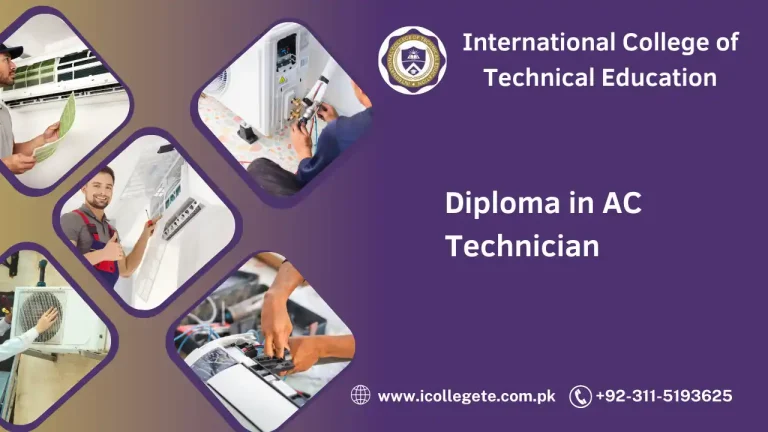
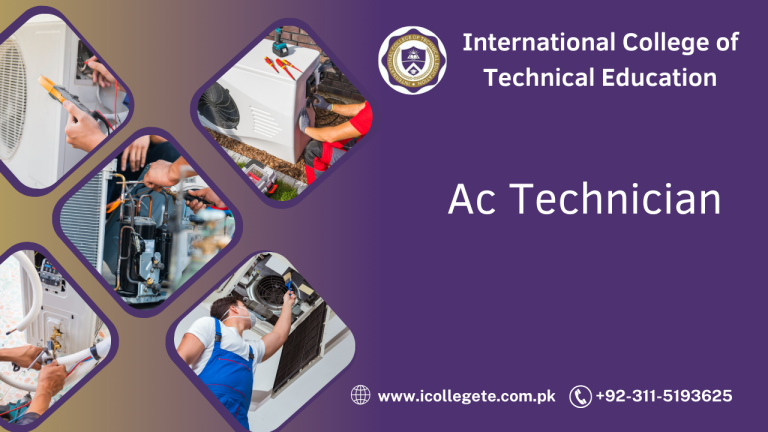
The AC Technician Training Course is a comprehensive program designed to provide students with the essential knowledge and practical skills required to become proficient air conditioning technicians. This course covers a wide range of topics, including the fundamentals of air conditioning systems, refrigeration principles, system installation, maintenance, troubleshooting, and repair techniques. Through a combination of theoretical instruction and hands-on training, students will develop the expertise needed to excel in the field of air conditioning technology.
Course Benefits: Upon completion of the AC Technician Training Course, participants will benefit from:
- In-Demand Skills: The course equips students with skills that are in high demand within the HVAC industry, increasing their employability and career opportunities.
- Practical Expertise: Students gain hands-on experience working with real-world air conditioning systems, allowing them to develop the practical skills necessary for success in the field.
- Industry-Recognized Certification: Graduates of the course receive a recognized certification, validating their expertise and enhancing their credibility as qualified AC technicians.
- Career Advancement: The course opens doors to entry-level positions in HVAC companies, and successful graduates can quickly progress to more advanced roles within the industry.
- Entrepreneurial Opportunities: Armed with the knowledge gained from the course, individuals may choose to start their own air conditioning repair and maintenance businesses.
Course Learning Outcomes: By the end of the AC Technician Training Course, students will be able to:
- Understand the fundamental principles of air conditioning and refrigeration systems.
- Perform installation, maintenance, and repair tasks on various types of air conditioning systems.
- Identify and troubleshoot common issues in air conditioning systems.
- Apply safety protocols and best practices when working with refrigerants and electrical components.
- Interpret technical diagrams, schematics, and manuals related to air conditioning systems.
- Demonstrate effective communication skills when interacting with clients and colleagues.
- Exhibit professionalism, ethics, and teamwork in a professional HVAC environment.
Course Study Units:
Introduction to Air Conditioning Technology
- Basics of air conditioning and its importance
- Historical development of air conditioning systems
- Types of air conditioning systems and their applications
- Environmental considerations and regulations
Refrigeration Principles
- The refrigeration cycle and its components
- Properties of refrigerants and their selection
- Heat transfer and thermodynamics in refrigeration
- Pressure-temperature relationships
Air Conditioning System Components
- Compressors, condensers, evaporators, and expansion valves
- Air handlers and ductwork
- Fans and blowers
- Thermostats and control systems
Installation and Maintenance
- Proper installation procedures for different types of air conditioning systems
- Preventive maintenance techniques to extend system lifespan
- Cleaning, lubrication, and filter replacement
- Energy efficiency considerations
Troubleshooting and Repair
- Common AC problems and their causes
- Diagnostic tools and techniques
- Repair and replacement of faulty components
- System recharging and leak detection
Safety and Regulations
- Safe handling of refrigerants and chemicals
- Electrical safety and grounding practices
- Compliance with industry standards and regulations
- Personal protective equipment (PPE) usage
Customer Service and Communication
- Effective communication with clients and colleagues
- Providing estimates, explaining repairs, and offering recommendations
- Handling customer complaints and inquiries
- Developing a professional demeanor
Entry Requirements: To enroll in the AC Technician Training Course, prospective students should meet the following entry requirements:
- High school diploma or equivalent qualification.
- Basic understanding of mathematics and physics.
- Good communication skills in the local language (reading, writing, and speaking).
- Physical ability to perform manual tasks and work in various environmental conditions.
Future Progressions: Upon successful completion of the AC Technician Training Course, graduates can explore various opportunities for career advancement and specialization, including:
- HVAC Technician: Graduates can work as entry-level HVAC technicians, performing a broader range of heating, ventilation, and air conditioning tasks.
- Specialized Technician: With additional training and experience, individuals can specialize in areas such as commercial refrigeration, industrial cooling systems, or solar-powered air conditioning systems.
- Supervisory Roles: Those with several years of experience can advance to supervisory or managerial positions within HVAC companies.
- Entrepreneurship: Some graduates may choose to start their own HVAC maintenance and repair businesses, offering services to residential and commercial clients.
- Continuing Education: Graduates can pursue further education and certifications in advanced HVAC technologies, energy-efficient systems, and emerging trends in air conditioning technology.
Conclusion:
the AC Technician Training Course equips individuals with the skills, knowledge, and certification needed to thrive in the competitive field of air conditioning technology. Through comprehensive instruction, practical experience, and a strong emphasis on safety and professionalism, participants will graduate ready to embark on a successful and rewarding career as skilled AC technicians.